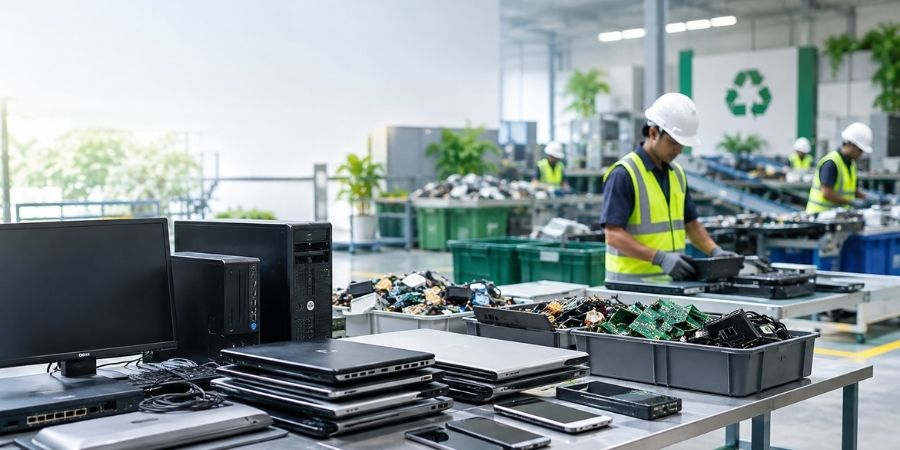
Electronic devices rarely disappear when we stop using them.
An old laptop may sit in an office storeroom for months. A broken printer may be moved from one corner to another. Retired servers, monitors, networking equipment, mobile phones and other electronic items can quickly accumulate without anyone having a clear plan for what happens next.
This is where e-waste management becomes important.
E-waste management is not simply about throwing old electronics away or sending them to a recycler. It involves collecting, sorting, storing, transporting, recovering, recycling and, where necessary, disposing of electronic waste in a responsible manner.
For businesses, there is another layer to consider: old IT equipment can contain sensitive information, while certain electronic components and batteries require careful handling.
This guide explains what e-waste management actually involves, how the process works, common mistakes to avoid, and when professional support can make sense.
What Is E-Waste Management?
E-waste management refers to the organized handling of discarded electrical and electronic equipment from the point it becomes unwanted through its final treatment, recycling, recovery or disposal.
E-waste can include items such as:
- Computers and laptops
- Servers and networking equipment
- Monitors and displays
- Printers and scanners
- Mobile phones and tablets
- Routers and other IT equipment
- Electronic components and peripherals
- Certain household and commercial electronic equipment
The goal is not simply to get these products out of a workplace or home.
A responsible process tries to ensure that useful materials are recovered where possible, hazardous components are handled appropriately, reusable equipment is identified, and waste does not end up being processed through unsafe or uncontrolled methods.
In India, the E-Waste (Management) Rules, 2022 came into force on April 1, 2023. The rules cover manufacturers, producers, refurbishers, dismantlers and recyclers involved with specified electrical and electronic equipment. They also establish an Extended Producer Responsibility framework for covered producers.
It is worth remembering that not every type of waste follows the same regulatory route. For example, waste batteries are separately covered under the Battery Waste Management Rules, 2022.
Why Does E-Waste Management Matter?
There are several reasons why responsible electronic waste disposal matters, particularly for businesses handling large volumes of equipment.
1. Electronics contain recoverable materials
Electronic equipment contains materials that can potentially be recovered during proper recycling and processing.
Depending on the equipment, these may include metals and other valuable materials. Recovering these resources reduces the need to treat discarded electronics simply as ordinary waste.
At the same time, electronic equipment can contain substances that require controlled handling. CPCB notes that e-waste may contain heavy metals and other substances that can create health and environmental risks during improper handling and recovery.
2. Old IT equipment can contain sensitive data
A computer may look useless after it has been replaced, but its storage drive could still contain business information.
Customer records, employee information, financial documents, emails, credentials, project files and other sensitive data may remain on a device even after files have been deleted.
That makes IT asset disposal different from simply disposing of an ordinary piece of office equipment.
For organizations handling sensitive information, data destruction should be considered as part of the asset retirement process.
3. Businesses may have compliance responsibilities
India’s E-Waste (Management) Rules, 2022 introduced an EPR framework for covered producers and require relevant recycling activities to be handled through registered recyclers.
The exact obligations depend on the organization, its role and the equipment involved. Businesses should therefore verify their specific regulatory responsibilities rather than assuming that every company has the same requirements.
4. Proper handling creates traceability
When a company sends hundreds or thousands of old devices for disposal, simply handing them over is not enough.
A structured process can provide better visibility into:
- What equipment was collected
- Where it was transported
- What was reused or refurbished
- What data was destroyed
- What was dismantled or recycled
- What documentation was generated
That record becomes particularly useful for organizations managing regular IT refresh cycles.
How Does the E-Waste Management Process Work?
The exact process varies depending on the type and quantity of equipment, but responsible e-waste management commonly involves several stages.
1. Collection
The process starts with collecting unwanted or end-of-life electronic equipment from homes, offices, institutions, warehouses or other locations.
For businesses, collection may involve everything from a few retired laptops to large quantities of computers, servers, monitors and networking equipment.
2. Sorting and Assessment
Once collected, equipment can be sorted according to its type, condition and potential next use.
A working laptop, for example, should not automatically be treated in exactly the same way as a damaged circuit board.
Assessment can help determine whether equipment should be:
- Reused
- Refurbished
- Re-marketed
- Dismantled
- Recycled
- Sent for appropriate disposal
This approach can help recover value before equipment enters the recycling stage.
3. Data Destruction
For IT equipment containing storage media, data security should be addressed before the asset leaves the organization’s control or enters further processing.
Depending on the circumstances, appropriate data destruction methods may include secure data wiping or physical destruction of storage media.
The right approach depends on the device, data sensitivity and organizational requirements.
4. Dismantling
Equipment that cannot reasonably be reused may be dismantled so that different components and materials can be separated.
This can include separating boards, metals, plastics, cables and other components.
The purpose is to make subsequent recovery and recycling more controlled.
5. Recycling and Material Recovery
Recyclable materials can then be processed through appropriate recycling channels.
The objective is to recover usable materials while avoiding uncontrolled treatment methods that could create unnecessary environmental or health risks.
CPCB’s E-Waste Management Rules framework places emphasis on environmentally sound management and recycling through the relevant registered channels.
6. Responsible Disposal
Not every component can be reused or recovered indefinitely.
Materials that require final disposal should be handled through appropriate channels rather than being mixed with ordinary municipal waste.
The entire process should ideally be traceable, especially when businesses are disposing of significant quantities of equipment.
E-Waste Management vs. IT Asset Disposition
The two terms are related, but they are not exactly the same.
E-waste management focuses primarily on the responsible handling, recycling, recovery and disposal of electronic waste.
IT Asset Disposition (ITAD) is broader from an IT asset perspective. It deals with what happens to technology assets when an organization retires them.
For example, an old company laptop might go through an ITAD process involving:
Asset identification → Data destruction → Condition assessment → Reuse/refurbishment → Resale or recycling
This matters because an asset does not necessarily become waste the moment a company stops using it.
A device may still have useful life.
A structured ITAD process can therefore help organizations decide whether an asset should be redeployed, refurbished, remarketed or recycled.
For companies retiring large quantities of computers, servers and networking equipment, professional IT Asset Disposition services can help organize this process.
Common E-Waste Disposal Mistakes
Even organizations that understand the importance of recycling can make avoidable mistakes.
Throwing electronics into regular waste
Old electronics should not simply be treated like ordinary office garbage. The appropriate route depends on the type of equipment and applicable requirements.
Assuming deleted files are permanently gone
Deleting a file or formatting a computer does not automatically mean that sensitive information has been securely destroyed.
Organizations should have a defined process for handling storage media before retired equipment is released.
Storing damaged batteries with other equipment
Batteries require specific handling considerations. Damaged, swollen or otherwise compromised batteries should not simply be mixed with general electronic waste.
Battery waste is also governed separately under India’s Battery Waste Management Rules, 2022.
Choosing a recycler without verification
A low-cost disposal option may not provide the documentation, traceability or environmentally sound processing a business expects.
Before selecting a service provider, organizations should verify the provider’s relevant registrations, authorizations and scope of services.
Losing track of assets
Large IT disposal projects can involve hundreds of individual assets.
Without proper inventory records, it becomes difficult to know what was collected, processed, reused, recycled or destroyed.
Best Practices for Responsible E-Waste Disposal
A practical e-waste policy does not have to be complicated.
For businesses, a few basic practices can make the process much easier:
- Maintain an asset inventory.
Keep track of devices before they leave the organization. - Separate reusable equipment from genuine waste.
A retired device may still have useful value. - Handle data before disposal.
Identify storage devices and establish an appropriate data destruction process. - Keep electronic and battery waste appropriately segregated.
Different waste streams can have different handling requirements. - Use verified recycling channels.
Check relevant registrations, authorizations and capabilities. - Maintain documentation.
Records of collection, processing and destruction can provide useful traceability. - Review the process regularly.
Companies with frequent hardware upgrades should treat asset disposition as an ongoing process rather than a one-time cleanup exercise.
When Should You Consider Professional E-Waste Management Services?
For a household with one broken keyboard, the disposal decision may be relatively simple.
For a company replacing 500 laptops, several servers and networking devices, the situation is very different.
Professional support can be useful when an organization has:
- Large quantities of electronic equipment
- Regular IT hardware replacement cycles
- Sensitive data stored on retired devices
- Old servers or networking infrastructure
- Battery waste requiring separate handling
- EPR-related responsibilities
- A need for collection and logistics
- Documentation or certificates related to disposal
- Multiple office locations
- A requirement for traceable recycling
This is where an organized service can save considerable administrative effort.
BRP Infotech provides e-waste management solutions covering areas such as electronic waste handling, recycling, IT asset disposition and related asset management services. The company’s published documentation also describes its recycling and IT asset disposition activities.
You can learn more about BRP Infotech’s E-Waste Management service if your organization is planning a larger electronic waste disposal project.
E-Waste Management in India: What Businesses Should Keep in Mind
India’s regulatory framework for e-waste has evolved significantly.
The E-Waste (Management) Rules, 2022 replaced the earlier 2016 rules and came into effect from April 1, 2023. The framework includes EPR requirements for relevant producers and emphasizes environmentally sound recycling through appropriate registered recyclers.
However, compliance should not be reduced to simply finding someone who will take away old electronics.
Organizations should first understand their role, the type of equipment involved and which rules apply to their particular waste stream.
For organizations with questions around EPR responsibilities, professional guidance can also be useful. Requirements can differ depending on whether an organization is a producer, manufacturer, importer, recycler, refurbisher or another covered entity.
Note: Regulatory requirements can change. Businesses should verify current CPCB requirements and applicable rules before making compliance decisions.
A Simple Example of Responsible Corporate E-Waste Disposal
Imagine an IT company replacing 300 employee laptops.
A weak approach would be:
Old laptops → Storage room → Unknown disposal vendor
A more structured approach would look like:
Asset inventory → Collection → Data destruction → Condition assessment → Reuse/refurbishment where appropriate → Dismantling/recycling → Documentation
The difference is not just environmental.
The second process gives the company better control over its assets, information security and disposal records.
That is the real value of a responsible e-waste management system.
Frequently Asked Questions
What is e-waste management?
E-waste management is the organized handling of discarded electrical and electronic equipment, including collection, sorting, reuse, recycling, recovery and appropriate disposal.
Why is e-waste management important?
Responsible management helps reduce uncontrolled disposal, supports material recovery and ensures electronic equipment is handled through appropriate channels. It is also important for businesses dealing with sensitive IT equipment and regulatory responsibilities.
How is e-waste recycled?
E-waste typically goes through collection, sorting, assessment and dismantling before suitable materials are recovered through recycling processes. The exact process depends on the equipment and the materials involved.
Can old computers be recycled?
Yes. Computers can contain recoverable materials and components. Before recycling business computers, however, organizations should consider whether the devices contain sensitive data and whether they can be reused or refurbished.
Is deleting files enough before disposing of a computer?
Not necessarily. Simply deleting files does not provide the same assurance as a properly defined data destruction process. Organizations handling sensitive information should use an appropriate data sanitization or destruction method.
Is battery waste the same as e-waste?
Not exactly. Battery waste is covered separately under India’s Battery Waste Management Rules, 2022. Businesses should therefore identify battery waste separately and follow the applicable handling requirements.
When should a business hire a professional e-waste management company?
Professional support can be useful when a business has large quantities of obsolete electronics, sensitive IT assets, battery waste, multiple locations, regular hardware replacement cycles or documentation and traceability requirements.
Conclusion
E-waste management is ultimately about making a better decision about what happens to electronics after their useful life.
The responsible approach is not simply to remove old equipment from an office. It is to understand what can be reused, protect sensitive information, separate different waste streams, recover useful materials and ensure the remaining waste is handled through appropriate channels.
For businesses, this becomes even more important as technology refresh cycles continue and the volume of retired IT equipment grows.
If your organization has old computers, servers, electronic equipment or other end-of-life assets that need to be handled responsibly, professional support can make the process more organized and traceable. BRP Infotech’s E-Waste Management services can be considered when you need structured support for electronic waste handling and recycling.