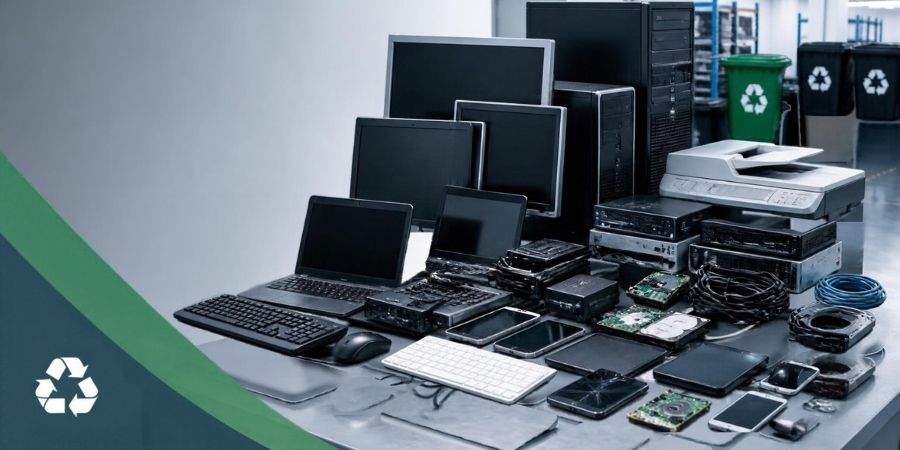
What should you do with an old laptop that no longer starts, a damaged mobile phone, or a box of unused office electronics? Many people keep these items in cupboards or storerooms because they are unsure how to dispose of them safely. Others hand them over to informal scrap collectors without considering what happens to the equipment afterward.
These situations are common in Indian households, offices, schools, IT companies, and manufacturing facilities. Electronic products eventually reach the end of their useful life, but that does not mean they should go into the regular dustbin.
Different types of e-waste require different handling methods. A laptop may contain sensitive business information, a damaged battery can present a fire risk, and an old television may contain materials that need specialised treatment.
Understanding the common types of electronic waste and their proper disposal methods helps individuals and businesses reduce avoidable risks, recover useful materials, and manage unwanted equipment responsibly.
What Is E-Waste?
E-waste, or electronic waste, refers to discarded electrical and electronic equipment, including devices, components, and accessories that have reached the end of their useful life or are no longer wanted.
Common examples include computers, printers, televisions, mobile phones, networking equipment, and electronic control devices. Some products can be repaired or refurbished, while others need to be dismantled and recycled through appropriate channels.
E-waste is not simply a collection of useless gadgets. Many electronic products contain recoverable materials, including metals, plastics, and glass. They may also contain substances that require careful handling during dismantling and recycling.
In India, the E-Waste (Management) Rules, 2022, as amended, provide the regulatory framework for covered electrical and electronic equipment. Waste batteries are addressed separately under the Battery Waste Management Rules, 2022, and subsequent amendments.
Why Does Proper E-Waste Disposal Matter?
The way electronic waste is handled after use affects more than just the amount of rubbish generated.
When electronic products are broken apart, burned, or processed without appropriate controls, hazardous substances can contaminate the surrounding environment and expose workers to health risks. Improperly handled batteries can also create fire hazards.
For businesses, there are additional concerns. Old laptops, servers, storage drives, and office computers may contain confidential files, customer information, financial records, or employee data. Simply discarding these devices without a suitable data sanitisation process can leave information exposed.
Responsible disposal also creates opportunities to recover materials and extend the useful life of equipment that can still be repaired or refurbished.
The following ten categories illustrate what electronic waste commonly looks like and how each type should be handled.
10 Common Types of E-Waste and Their Proper Disposal Methods
1. Computers and Laptops
Desktop computers and laptops are among the most familiar forms of electronic waste. Businesses regularly replace computers because of hardware failures, performance limitations, software requirements, or planned technology upgrades.
These devices contain circuit boards, metals, plastics, power components, and sometimes rechargeable batteries. Their storage drives may also contain sensitive information.
How should they be disposed of?
First, determine whether the computer can be repaired, upgraded, or refurbished for further use. If it is no longer suitable for reuse, transfer it to an appropriate e-waste collection or recycling channel.
Before handing over a business computer, ensure that its data is securely sanitised or that the storage device is physically destroyed when required by the organisation’s data security policy. Keep an asset record and disposal documentation for corporate equipment.
Businesses retiring large numbers of computers can benefit from a structured IT Asset Disposition (ITAD) process, which helps coordinate equipment assessment, data handling, and end-of-life management.
2. Mobile Phones and Tablets
Old smartphones and tablets often remain unused after an upgrade. Although they are small, they contain circuit boards, screens, rechargeable batteries, and components that can be recovered or require specialised treatment.
They may also hold personal photographs, saved passwords, emails, business documents, and account credentials.
How should they be disposed of?
If the device still works, consider repairing it, passing it on, or using an appropriate refurbishment or take-back programme. Before transferring ownership, back up important files, sign out of accounts, remove SIM and memory cards, and perform a factory reset. For business devices, follow the organisation’s approved data sanitisation process rather than relying on a reset alone.
Damaged or obsolete devices should go through a suitable electronics collection or recycling channel. Do not dismantle a phone yourself if its battery is swollen or damaged.
3. Printers, Scanners, and Photocopiers
Printers and photocopiers are common in offices, schools, banks, and educational institutions. They may become waste when repairs are no longer practical or when organisations move to newer equipment.
These machines contain electronic boards, motors, wiring, plastics, and other components. Some multifunction printers and office copiers also store scanned images, print jobs, address books, or other information.
How should they be disposed of?
Check whether the machine can be repaired or reused. Remove consumables such as toner cartridges and ink cartridges according to the manufacturer’s instructions, and send them through suitable collection programmes.
Before disposing of a networked printer or copier, check whether it has internal storage and whether stored information needs to be securely erased. Route equipment that cannot be reused through an appropriate e-waste recycler.
4. Televisions and Computer Monitors
Televisions and monitors vary considerably in construction. Older cathode-ray tube (CRT) displays are different from modern LED, LCD, and other flat-panel screens.
Their components may include glass, plastics, electronic boards, and metals. Certain older display technologies can contain hazardous substances that require controlled treatment.
How should they be disposed of?
Do not break screens or CRT units to make them easier to transport. Keep them intact and arrange collection through an appropriate electronics take-back or recycling channel.
Working displays may be suitable for reuse. Damaged or obsolete units should be sent to a recycler equipped to handle the relevant display technology.
5. Batteries and Power Banks
Batteries are found in laptops, smartphones, tablets, wireless accessories, power banks, and many other electronic products. They deserve special attention because certain battery types, particularly lithium-ion batteries, can catch fire if damaged, crushed, punctured, or short-circuited.
Battery waste also includes products such as household cells, vehicle batteries, and industrial batteries. These should not all be treated as the same waste stream.
How should they be disposed of?
Never put waste batteries into ordinary household rubbish or mix loose batteries with scrap metal. Use an appropriate battery collection programme or authorised channel.
Store batteries in a dry, protected location away from heat and physical damage. Where recommended for the battery type, protect exposed terminals against short circuits. Do not attempt to open, crush, or repair damaged batteries.
If a battery is swollen, leaking, unusually hot, or otherwise damaged, avoid handling it unnecessarily and seek guidance from an appropriate battery-waste professional. If it is smoking or actively overheating, move away and contact emergency services.
Businesses with substantial quantities of battery waste should arrange suitable segregation, storage, transport, and recycling. BRP Infotech provides information about its battery waste disposal services.
6. Networking Equipment and Servers
Routers, switches, modems, firewalls, servers, and other networking equipment are widely used by offices, data centres, educational institutions, and technology companies.
When organisations upgrade their infrastructure, large quantities of functioning and non-functioning equipment may be retired together. Some of these assets can be reused, while others need recycling.
How should they be disposed of?
Start by identifying each asset and determining whether it can be refurbished or redeployed. Servers, storage arrays, and network devices should be checked for stored information, configuration files, credentials, and other sensitive data.
Secure data sanitisation should take place before equipment leaves the organisation’s control, according to its security requirements. Equipment that cannot be reused should be transferred through a documented IT asset disposal process.
7. Cables, Chargers, and Adapters
Old charging cables, power adapters, Ethernet cables, extension accessories, and computer leads tend to accumulate unnoticed. They may seem harmless because they are relatively simple products, but they contain copper or other conductive materials, insulation, plastics, and connectors.
How should they be disposed of?
Separate unwanted cables and adapters from general rubbish and collect them for an appropriate e-waste or cable-recycling programme. Reusable accessories can be kept for compatible equipment or passed on when safe and functional.
Avoid burning cable insulation to recover metal. Uncontrolled burning releases harmful pollutants and creates unnecessary health and environmental risks.
8. Small Household Appliances
Electric kettles, mixers, toasters, irons, electric fans, and similar appliances can become waste when they stop working or are replaced.
Although these products are used in everyday life, they contain electrical components, wiring, motors or heating elements, and materials that may be recovered.
How should they be disposed of?
Check whether the appliance can be repaired safely. If it cannot, use an appropriate electronics collection or recycling channel. Unplug the appliance and remove detachable accessories where practical, but do not dismantle electrical components unless you are trained and equipped to do so.
Appliances containing built-in batteries or other specialised components may require additional handling.
9. Electronic Toys, Wearables, and Personal Gadgets
Smartwatches, fitness trackers, electronic toys, wireless headphones, digital cameras, and similar gadgets often end up forgotten in drawers.
Their small size can make them easy to overlook, but many contain circuit boards, sensors, rechargeable batteries, and other electronic components.
How should they be disposed of?
Reuse or repair working products where practical. For devices with personal accounts or stored data, remove account access and sanitise the data where supported.
Collect obsolete gadgets separately and use a suitable e-waste collection programme. Do not assume that a product is safe for general waste simply because it is small or inexpensive.
10. Electronic Components and Circuit Boards
Circuit boards, memory modules, electronic control units, and other components arise during equipment repairs, manufacturing, maintenance, and large-scale IT upgrades.
Some circuit boards contain recoverable metals, while other components may include substances that require specialised processing. Their composition varies by product and manufacturer.
How should they be disposed of?
Keep electronic components segregated from ordinary waste and send them to an appropriate electronics recycler. Avoid informal chemical extraction or uncontrolled dismantling.
For organisations generating regular volumes of electronic components, a documented collection and recycling arrangement can help track quantities, support responsible handling, and maintain disposal records.
How Does the E-Waste Disposal Process Work?
The correct disposal route depends on the type, condition, and quantity of equipment involved. However, a responsible process usually follows a few practical steps.
- Collection and segregation
Gather unwanted equipment and separate reusable devices, damaged electronics, loose batteries, and other components. Keep potentially hazardous items separate.
- Assessment for reuse or recycling
Check whether equipment can be repaired, refurbished, or redeployed. Recycling should be considered when further use is not practical.
- Data sanitisation
For devices containing storage media, use an appropriate data sanitisation method before reuse or disposal. Record the outcome when required.
- Recycling and material recovery
Suitable recyclers dismantle and process equipment using appropriate methods to recover usable materials and manage hazardous fractions.
- Documentation and final handling
Maintain relevant collection, transfer, and recycling records. Businesses should ensure that equipment reaches an appropriate destination and that any applicable compliance requirements are addressed.
Common E-Waste Disposal Mistakes to Avoid
Even when people understand that electronic waste should be recycled, a few everyday mistakes can create unnecessary problems.
- Throwing electronics into regular rubbish: Small gadgets and broken appliances still need an appropriate disposal route.
- Mixing batteries with other scrap: Damaged or short-circuited batteries can create safety hazards during storage and transport.
- Assuming deleted files are permanently gone: Ordinary deletion or a factory reset may not meet an organisation’s data sanitisation requirements.
- Selling every old device as scrap: Some equipment can be repaired or reused, while other assets require secure data handling before transfer.
- Choosing a recycler without checking credentials: Ask about applicable registrations, the handling process, downstream recycling arrangements, and documentation.
- Ignoring business records: Organisations should maintain suitable asset lists, transfer records, and disposal evidence instead of relying only on verbal confirmation.
For businesses covered by India’s E-Waste (Management) Rules, 2022, and subsequent amendments, applicable responsibilities should be checked against the current requirements and the organisation’s role. Battery waste is governed separately under the Battery Waste Management Rules, 2022, and subsequent amendments.
Best Practices for Responsible E-Waste Management
Good disposal practices begin before equipment becomes waste. A few simple measures can make the process easier to manage.
For households:
- Keep old electronics separate from everyday rubbish.
- Use suitable collection or take-back programmes.
- Remove personal accounts and data before transferring devices.
- Store damaged batteries safely and seek appropriate handling advice.
For businesses and institutions:
- Maintain an inventory of retired IT assets, including serial numbers where available.
- Establish a process for approving equipment reuse, resale, and recycling.
- Sanitise sensitive data before releasing storage devices.
- Segregate battery waste from other electronic waste.
- Check the credentials and suitability of the receiving recycler or service provider.
- Retain relevant handover records, recycling documentation, and data destruction evidence.
These practices are particularly useful for organisations that regularly replace laptops, desktops, servers, printers, or networking equipment. A consistent process helps IT, procurement, administration, and compliance teams work from the same records.
When Should You Consider Professional E-Waste Disposal Services?
A household with one broken keyboard may only need a suitable collection point. An organisation replacing hundreds of computers has a different set of requirements.
Professional support can be useful when a business needs to dispose of large quantities of electronic equipment, retire data-bearing assets, manage battery waste, or document how equipment has been handled.
The right service depends on the requirement:
- E-waste management: For organised collection, segregation, and responsible recycling of discarded electronics.
- IT Asset Disposition (ITAD): For assessing, tracking, reusing, or recycling retired corporate IT equipment.
- Data destruction: For securely sanitising or destroying storage media according to the organisation’s needs.
- Battery waste disposal: For the appropriate handling and routing of waste batteries.
BRP Infotech provides services in these areas. Businesses can review its e-waste management services or IT Asset Disposition solutions to understand which approach may suit their requirements.
Conclusion
E-waste includes far more than old computers and mobile phones. Batteries, office equipment, cables, household appliances, servers, and electronic components all need suitable end-of-life handling.
The practical starting point is to identify what you have, determine whether it can be reused, protect any stored data, and select an appropriate collection or recycling route. Batteries and sensitive electronic equipment may require additional precautions.
For organisations, a documented process makes it easier to track retired assets and manage their final destination responsibly. BRP Infotech offers e-waste management and IT asset disposal services for businesses looking to handle end-of-life electronics more systematically.
7. FAQs
1. What are the most common types of e-waste?
Common types include computers, laptops, mobile phones, tablets, printers, televisions, batteries, networking equipment, cables, household appliances, electronic gadgets, and circuit boards.
2. Can e-waste be thrown into a regular dustbin?
Electronic waste should not be mixed with ordinary household rubbish. Use an appropriate collection, take-back, or recycling channel for the equipment involved.
3. How should old computers and laptops be disposed of?
First, check whether they can be repaired or reused. Before transferring them, sanitise stored data appropriately. Equipment that cannot be reused should go through a suitable electronics recycling or IT asset disposal process.
4. Why should batteries be separated from other e-waste?
Batteries may contain materials that require specialised processing. Damaged or improperly stored batteries can also cause fires. Separating them helps ensure suitable handling and recycling.
5. What happens to electronic waste after collection?
Depending on its condition, equipment may be tested for reuse, refurbished, dismantled, or sent for recycling. Recyclers recover suitable materials and manage remaining waste through appropriate processes.
6. Is e-waste recycling mandatory for businesses in India?
Applicable obligations depend on the organisation’s role, the equipment involved, and the current rules. India’s E-Waste (Management) Rules, 2022, as amended, cover specified electrical and electronic equipment and relevant entities. Businesses should check the latest official requirements rather than assume that the same obligations apply to everyone.
7. How can a company ensure that old IT equipment is disposed of responsibly?
Maintain an asset inventory, protect sensitive data, select an appropriate service provider, check relevant registrations, and retain suitable transfer and disposal records. A structured ITAD process can help coordinate these activities.