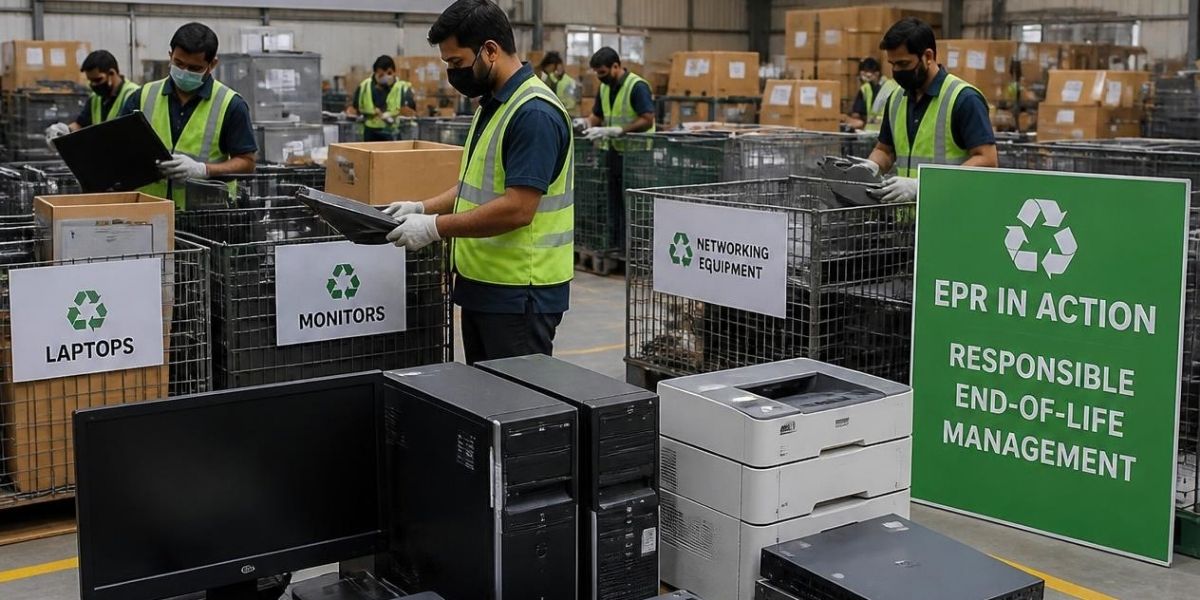
If your company manufactures, imports, or sells products that eventually become waste, one question becomes increasingly important: who is responsible for that waste after the product reaches the end of its useful life?
This is where Extended Producer Responsibility (EPR) comes in.
EPR changes the traditional approach to waste management by placing responsibility on producers and other obligated entities to help ensure that covered products and materials are properly collected, recycled, recovered, or otherwise managed at the end of their useful life.
In India, EPR is not one single rule covering every type of waste. Different waste streams, including e-waste, batteries, plastic packaging, waste tyres and used oil, are governed through different regulatory frameworks.
For businesses dealing with electrical and electronic equipment, understanding EPR is particularly important because India’s E-Waste (Management) Rules, 2022 introduced a structured EPR framework for covered electrical and electronic equipment. The rules came into force on 1 April 2023.
This guide explains what EPR means, how it works in India, who may have obligations, and what businesses should consider when managing their compliance responsibilities.
What Is Extended Producer Responsibility?
Extended Producer Responsibility (EPR) is an approach to waste management where producers have responsibilities related to the environmental management of products after they become waste.
The basic idea is straightforward.
A product does not stop having an environmental impact simply because it has been sold. When that product eventually becomes waste, its materials may need to be collected, processed, recycled or otherwise managed appropriately.
Under India’s E-Waste (Management) Rules, 2022, EPR specifically means the responsibility of producers of covered electrical and electronic equipment to meet prescribed recycling targets through registered e-waste recyclers and ensure environmentally sound management of the waste.
So, EPR is more than simply “disposing of waste.”
It creates a system in which the producer’s responsibility extends into the post-consumer stage of the product’s life cycle.
Why Does EPR Matter for Businesses?
EPR matters because waste management can no longer be treated as an issue completely separate from the products that businesses place on the market.
For an electronics manufacturer or importer, for example, the responsibility does not necessarily end when a laptop, monitor, appliance or other covered product is sold.
The business may have obligations connected with the waste generated from those products.
There are several practical reasons this matters.
Environmental responsibility
Electronic products contain valuable materials as well as substances that require controlled handling. CPCB notes that e-waste can contain materials such as precious metals while also containing substances that can pose risks during improper handling and recovery.
A structured EPR system helps move waste toward formal recycling and environmentally sound management rather than uncontrolled disposal.
Regulatory compliance
Businesses covered by the relevant rules may have registration, reporting and EPR fulfilment responsibilities.
For e-waste, CPCB states that producer registration is mandatory for entities falling within the definition of “Producer” under the E-Waste (Management) Rules, 2022.
Resource recovery
Recycling can recover materials from products that would otherwise become waste. The E-Waste Rules’ EPR framework focuses on recycling and provides for EPR certificates based on recycled end products.
Better traceability
A formal EPR framework creates documentation and reporting requirements around waste management. For businesses, that can make it easier to demonstrate how their obligations have been addressed.
How Does EPR Work in India?
The exact process depends on the type of waste and the applicable rules. There is no single EPR procedure that applies identically to every industry.
For e-waste, the basic structure can be understood as follows:
Product placed on the market → EPR obligation → Registered recycling system → EPR certificate/fulfilment → Reporting and compliance
Under the E-Waste (Management) Rules, 2022, producers of covered electrical and electronic equipment are required to meet prescribed recycling obligations through registered e-waste recyclers.
1. Determine whether the business is covered
The first step is understanding whether the company’s products and activities fall within the applicable definition and schedules.
The E-Waste Rules apply to specified electrical and electronic equipment listed in Schedule I, including relevant components, consumables, parts and spares. The rules also specifically exclude certain waste streams, such as waste batteries covered under the Battery Waste Management Rules, 2022.
This distinction is important because a company may deal with several different waste categories, each having its own regulatory framework.
2. Register where required
Covered producers need to follow the applicable registration requirements.
For e-waste, CPCB’s FAQ states that producer registration is mandatory for entities covered by the definition of Producer under the 2022 Rules.
3. Understand the EPR obligation
An EPR obligation is the amount or target that an obligated entity must fulfil under the applicable rules.
For e-waste, CPCB describes phase-wise recycling obligations under the 2022 framework. Its published FAQ lists 60% for FY 2023-24 and FY 2024-25, 70% for FY 2025-26 and FY 2026-27, and 80% from FY 2027-28 onwards for the relevant category of producer obligations. The applicable calculation can differ for newer producers and certain other circumstances, so businesses should verify the current requirement applicable to their registration and product category.
Because EPR requirements can be amended or supplemented through notifications and official guidance, companies should verify current requirements rather than relying on an old compliance checklist.
4. Work with registered recyclers
For e-waste, the rules require EPR obligations to be fulfilled through registered e-waste recyclers. CPCB’s framework provides for EPR certificates generated through recycling activity and used by producers to fulfil their obligations.
This makes the choice of recycling partner an important part of the overall compliance process.
5. Maintain records and complete reporting
Compliance does not end after arranging recycling.
Businesses may need to maintain relevant records and submit applicable returns through the prescribed system. CPCB identifies quarterly and annual returns as part of the E-Waste Rules framework.
Good documentation is therefore an operational requirement, not just paperwork.
EPR Is Different for Different Waste Streams
One common misunderstanding is that “EPR” means exactly the same thing for every type of waste.
It does not.
For example, e-waste is governed under the E-Waste (Management) Rules, 2022, while waste batteries are governed under the Battery Waste Management Rules, 2022. The latter introduced EPR responsibilities for battery producers and requires producers to register with CPCB through the prescribed system.
Waste tyres have a separate EPR framework as well. CPCB’s Waste Tyre EPR Portal provides separate registration and obligation mechanisms for producers, recyclers and retreaders.
This is why a company should first identify which waste stream and regulatory framework applies to its products before deciding what its EPR process should look like.
Common EPR Challenges and Mistakes Businesses Should Avoid
EPR compliance can become complicated when businesses treat it as a one-time registration exercise.
Assuming registration is the entire job
Registration is only one part of the process. Businesses also need to understand their obligations, fulfil them through the applicable mechanism and complete required reporting.
Choosing an unverified recycling partner
For e-waste, the regulatory framework specifically relies on registered recyclers. Working with an inappropriate or unverified channel can create compliance and traceability problems.
Poor record keeping
Sales information, waste quantities, recycling documentation and certificate-related records may become important during compliance activities.
A business should establish an internal system for maintaining relevant information instead of trying to reconstruct it at the end of the reporting period.
Treating different waste categories as the same
An organisation may have computers, batteries, packaging and other waste streams at the same location.
That does not mean they should all be handled under the same EPR process.
The applicable rules and obligations need to be identified separately.
Relying on outdated information
EPR frameworks continue to develop through amendments, notifications, official guidance and portal changes.
For compliance-related decisions, businesses should verify current requirements from CPCB and the relevant government authorities.
Best Practices for Managing EPR Compliance
A practical EPR approach starts well before waste reaches a recycling facility.
Businesses can consider the following:
- Identify which products and waste streams fall under applicable EPR frameworks.
- Keep accurate product, sales and waste-related records.
- Understand the EPR obligation applicable to each relevant product category.
- Use registered or otherwise appropriately authorised waste-management partners as required by the applicable rules.
- Maintain documentation for collection, recycling and certificate-related activities.
- Keep compliance responsibilities assigned to specific people within the organisation.
- Review regulatory updates periodically.
- Separate e-waste, battery waste and other regulated waste streams rather than treating everything as general waste.
For companies handling large volumes of electronic equipment, it can also be useful to connect EPR processes with broader e-waste management and IT asset disposal procedures.
When Should a Business Consider Professional EPR Services?
Professional support can be useful when EPR becomes difficult to manage internally.
This is particularly relevant for businesses that:
- Manufacture or import covered electronic products
- Operate across multiple locations
- Handle significant volumes of electronic equipment
- Need help understanding their EPR obligations
- Require structured documentation
- Need support coordinating with appropriate recycling channels
- Have multiple regulated waste streams
- Want better traceability of their waste-management process
A professional service provider can help businesses organise the operational side of waste collection, recycling and documentation while the company retains responsibility for providing accurate business and compliance information.
For organisations specifically looking for help with EPR-related processes, BRP Infotech’s EPR Services can be considered alongside the company’s broader waste-management requirements.
The right approach depends on the company’s products, quantities, regulatory category and current compliance position.
How EPR Connects With Responsible E-Waste Management
EPR works best when it is not treated as an isolated compliance task.
Consider a company replacing hundreds of computers across its offices.
There may be several connected requirements:
Asset retirement → Data protection → Collection → Segregation → Recycling → Documentation → EPR-related compliance
The equipment may contain sensitive business information, while the physical devices contain materials that should be recovered through appropriate recycling channels.
That is why EPR, e-waste recycling, IT Asset Disposition and data destruction can sometimes form part of the same broader end-of-life asset management process.
For businesses looking at the physical management of obsolete electronic equipment, BRP Infotech’s E-Waste Management service provides a relevant starting point.
A Practical EPR Checklist for Businesses
Before considering an EPR process complete, a business should be able to answer questions such as:
- Which of our products or materials fall under an EPR framework?
- Which rules apply to each waste stream?
- Are we required to register?
- What is our applicable EPR obligation?
- How will the obligation be fulfilled?
- Are our recycling or waste-processing partners appropriately registered or authorised?
- What records do we need to maintain?
- Have the required returns or reports been submitted?
- Can we trace the waste-management process through appropriate documentation?
- Have we checked for recent regulatory or portal updates?
If several of these questions do not have clear answers, it may be worth reviewing the company’s compliance process.
7. FAQs
What does EPR stand for?
EPR stands for Extended Producer Responsibility. It is a policy and regulatory approach that extends certain responsibilities of producers into the post-consumer stage of a product’s life.
What is EPR in India?
In India, EPR is implemented through different waste-management frameworks. For example, the E-Waste (Management) Rules, 2022 establish EPR obligations for producers of covered electrical and electronic equipment.
Who needs EPR registration for e-waste?
Entities that fall within the definition of Producer under the E-Waste (Management) Rules, 2022 are required to obtain producer registration, according to CPCB’s published FAQ.
Is EPR the same for e-waste and battery waste?
No. E-waste and battery waste are covered by separate regulatory frameworks. E-waste is governed by the E-Waste (Management) Rules, 2022, while waste batteries are covered by the Battery Waste Management Rules, 2022.
What is an EPR certificate?
An EPR certificate is a mechanism used within applicable EPR systems to document recycling or other qualifying activity and help obligated entities fulfil their prescribed obligations. Under India’s e-waste framework, CPCB describes EPR certificates generated through recycling and used by producers to meet their obligations.
Does EPR only apply to manufacturers?
Not necessarily. The definition of an obligated entity depends on the specific waste-management rules. For e-waste, the framework covers defined categories of manufacturers, producers and other stakeholders. Businesses should check the applicable rules rather than assuming that only manufacturers are affected.
Can a business manage EPR internally?
Yes, depending on its size, products, obligations and internal resources. However, businesses with complex product portfolios, significant waste volumes or documentation requirements may choose to work with professional waste-management or EPR service providers.
Conclusion
EPR represents a shift in the way businesses think about products and waste. The responsibility associated with a product does not necessarily end at the point of sale.
For companies dealing with electronics, understanding the applicable EPR framework means looking beyond registration. They need to understand their obligations, work through appropriate recycling channels, maintain records and keep up with regulatory requirements.
The exact process depends on the product and waste stream involved, so businesses should always verify the current requirements applicable to them through official regulatory sources.
If your organisation has electronic waste or end-of-life equipment that needs structured and responsible handling, professional support can make the process more manageable and traceable. BRP Infotech provides EPR and e-waste management solutions for businesses that need support with responsible waste handling.