What happens to an old laptop after an office replaces it? Where do broken mobile phones, discarded printers, damaged monitors and outdated electronic equipment go once they are no longer useful?
Many electronic devices contain materials that can be recovered and used again. They may also contain components that require careful handling. Simply throwing them away does not address either concern.
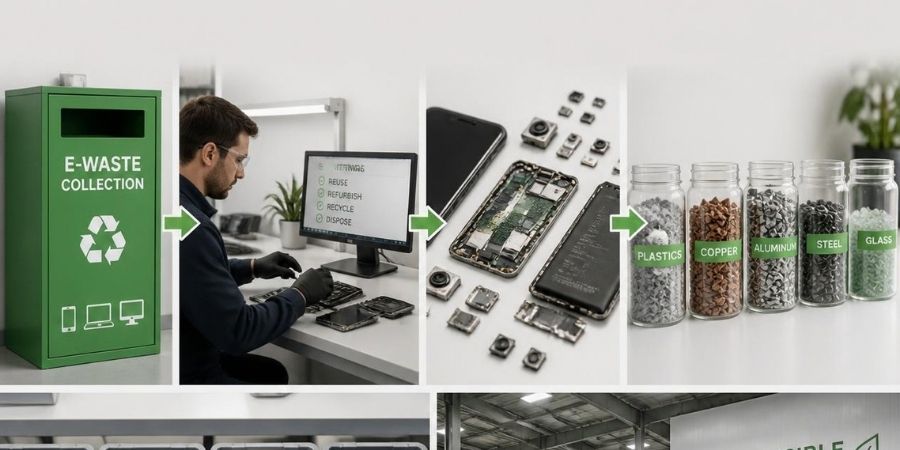
This is where the e-waste recycling process comes in. It involves much more than collecting old electronics and breaking them apart. Responsible recycling requires sorting, assessment, safe dismantling, material recovery and proper management of the remaining waste.
For households, this process helps make electronic disposal more responsible. For businesses, it also provides a structured way to manage retired equipment, protect sensitive information and maintain records of how assets are handled.
Let’s look at how e-waste recycling works, step by step.
What Is E-Waste Recycling?
E-waste recycling is the process of recovering usable materials from discarded electrical and electronic equipment while managing components and residues that cannot be recovered safely or economically.
E-waste can include computers, laptops, mobile phones, televisions, printers, networking equipment, circuit boards and many other electrical or electronic products.
When these products reach the end of their useful life, they may still contain metals, plastics, glass and electronic components that have value as secondary materials. Recycling helps recover some of these resources rather than allowing them to be lost through improper disposal.
However, not every discarded device needs to be recycled immediately. If equipment is still functional or can be repaired, reuse or refurbishment may be a practical option. Recycling generally becomes relevant when equipment is no longer suitable for continued use or recovery through reuse.
The aim is to keep useful materials in circulation while ensuring that hazardous components and unrecoverable residues are handled appropriately.
Why Does E-Waste Recycling Matter?
Electronic products are made from a mixture of materials. Some can be recovered, while others need specialised handling. What happens to these materials after disposal makes a difference.
It helps recover valuable resources
Electronic equipment can contain copper, aluminium, iron and, in certain components, precious metals such as gold. Recycling facilities use appropriate processes to recover selected materials from discarded products.
Recovered materials can then enter other manufacturing supply chains, reducing the need to rely entirely on newly extracted raw materials.
The exact materials and quantities recovered depend on the type of equipment, its composition and the recycling technology used.
It reduces the risks of improper disposal
Discarded electronics may contain lead, mercury, certain flame retardants and other substances that can pose environmental or health risks if handled improperly.
Breaking equipment apart without suitable controls, burning cables or circuit boards, or using unsuitable chemical methods can expose workers and surrounding areas to harmful substances.
Responsible recycling uses appropriate processes to separate recoverable materials and manage hazardous fractions and residues.
It supports more responsible business operations
Offices, factories, educational institutions, hospitals and IT companies regularly replace computers, printers, networking devices and other equipment.
Without a planned disposal process, old assets can accumulate in storage rooms, become mixed with general waste or leave the organisation without a clear record of their final destination.
A structured e-waste programme helps businesses organise collection, identify equipment, arrange suitable recycling and maintain records.
In India, the E-Waste (Management) Rules, 2022, effective from 1 April 2023, establish a regulatory framework for specified electrical and electronic equipment and relevant stakeholders. The rules have also been amended, so businesses should check the applicable requirements for their activities. Official rules: Ministry of Environment, Forest and Climate Change.
How Does the E-Waste Recycling Process Work?
The precise process varies according to the equipment, the condition of the items and the capabilities of the recycling facility. However, a responsible process generally follows several stages.
1. Collection of Electronic Waste
The process begins when discarded or end-of-life electronic equipment is collected from households, offices, institutions, retailers or other sources.
For an individual, this might mean handing over an old mobile phone or laptop through an appropriate collection channel. For a business, collection may involve dozens or hundreds of devices from different departments or locations.
Proper collection matters because electronics should not automatically be mixed with household rubbish or general office waste. Keeping them separate makes subsequent identification, transportation and treatment easier.
Businesses can make this stage more manageable by maintaining a list of retired equipment, identifying collection locations and setting a clear process for handing over unwanted devices.
2. Transportation and Initial Handling
Once collected, the equipment must be transported to the appropriate receiving or processing facility.
Devices should be packed and handled in a way that reduces the risk of breakage, leakage or other damage. Particular care is needed for equipment with damaged batteries or components that could create safety concerns.
Large organisations may also need to coordinate collection schedules, access to storage areas and records of the equipment being transferred.
The objective is straightforward: move the collected material to the next stage without creating avoidable risks or losing track of what has been handed over.
3. Sorting and Assessment
At the receiving facility, electronic waste is sorted according to its type, condition and likely treatment route.
A batch might contain desktop computers, laptops, monitors, printers, cables and circuit boards. These items are not necessarily processed in the same way, so separating them helps determine the next steps.
During assessment, equipment may be identified as:
- Suitable for possible repair, refurbishment or reuse.
- Suitable for dismantling and material recovery.
- Requiring special handling because of its components or condition.
- Requiring a separate treatment route for particular materials or residues.
This stage is especially relevant for business IT equipment. A working laptop may still have reuse value, while a damaged or obsolete device may be more suitable for dismantling and recycling.
The decision should be based on the equipment’s condition, safety, data security needs and the available recovery options.
4. Data Destruction for Devices That Store Information
Not every item of e-waste stores information, but computers, smartphones, servers and storage devices can contain confidential or personal data.
Before such equipment is reused, refurbished or dismantled, organisations should determine how its data will be protected. Deleting files or resetting a device may not be sufficient for every storage medium or risk level.
Depending on the device and the organisation’s requirements, suitable methods may include verified data erasure or physical destruction of the storage media.
Data destruction is a separate but important part of responsible IT equipment disposal. It should be completed at the appropriate point in the workflow, with records retained where required.
Businesses managing retired computers, servers and storage devices can explore BRP Infotech’s data destruction services to understand the available options for secure data disposal.
5. Dismantling and Component Separation
After assessment and any necessary data-security steps, equipment selected for recycling may be dismantled.
This involves separating products into components or material fractions. For example, a desktop computer may be separated into its casing, cables, circuit boards, power supply and other parts.
Depending on the equipment, batteries, screens, plastics, metals and electronic assemblies may require different handling methods.
Some dismantling tasks can be performed manually, while other stages may use specialised machinery. The methods used depend on the product and the facility’s processes.
This is also where controlled handling becomes particularly important. Informal dismantling methods, such as burning cables to recover metal or using unsafe chemical treatments, can create serious environmental and worker-safety risks.
6. Material Recovery and Recycling
Once components have been separated, suitable material fractions move through further processing.
Depending on the material, this may involve mechanical separation, shredding, screening, magnetic separation or specialised metallurgical processes. Not every facility uses every method, and different materials require different treatment routes.
For example:
- Metals: Suitable fractions may be processed to recover iron, copper, aluminium and other metals.
- Plastics: Recoverable plastic fractions may be sorted and processed according to their composition and quality.
- Circuit boards: These may undergo specialised processing to recover selected metals.
- Glass and other materials: Certain fractions may be recovered or sent for appropriate treatment, depending on their composition.
The recovered output is not always ready to be used directly in a new product. It may need additional processing before it can be supplied to a manufacturer or another authorised processor.
Effective recycling is therefore about separating materials correctly and sending each fraction to a suitable downstream destination.
7. Treatment and Responsible Disposal of Residues
Recycling does not mean that every part of every electronic device can be recovered.
Some components and residues may not be recyclable through a particular facility’s process. Others may require specialised treatment because of their composition or contamination.
These materials must not simply be dumped or mixed with ordinary waste. They should be directed to the appropriate authorised treatment, storage or disposal route, as applicable.
India’s E-Waste (Management) Rules, 2022, place responsibilities on registered recyclers, including requirements concerning material fractions not recycled at their own facilities and residues generated during recycling. Read the official rules on the CPCB website.
For businesses, it is worth asking a recycling provider how non-recoverable materials are handled, rather than focusing only on the quantity of material collected.
8. Documentation and Traceability
The final stage is not just about where the material goes. It is also about whether the organisation can establish what happened to it.
Depending on the arrangement and applicable requirements, useful records may include collection details, asset or material lists, handover documents, processing information and relevant recycling or disposal documentation.
For businesses, these records help internal teams track retired equipment and respond to audits or reporting needs where applicable.
Documentation should accurately reflect the work performed. A collection receipt, for example, is not necessarily proof that every item has completed recycling. Organisations should understand what each document confirms and whether additional evidence is required.
Common E-Waste Recycling Mistakes to Avoid
Even when the intention is to dispose of electronics responsibly, a few common mistakes can undermine the process.
Mixing electronics with general waste: This makes suitable collection and recovery more difficult. Keep discarded electronics separate and use an appropriate collection route.
Choosing a provider based only on collection price: Cost matters, but so do handling practices, traceability and the destination of the collected material. Ask what happens after pickup.
Ignoring data stored on devices: Old computers and phones may retain business or personal information. Plan for secure data sanitisation before reuse or disposal.
Storing damaged batteries carelessly: Batteries may need separate handling, especially if they are swollen, leaking or damaged. Do not treat battery waste as interchangeable with ordinary electronic scrap.
Assuming all collected material is recycled: Some fractions may need further processing or authorised disposal. Ask how the provider manages materials that cannot be recovered.
Best Practices for Responsible E-Waste Management
A few practical steps can make electronic waste management easier for households and organisations.
- Separate e-waste at the source. Keep discarded electronics away from general waste and identify items that may still be suitable for repair or reuse.
- Maintain an asset register. Businesses should record equipment being retired, particularly when devices are assigned to specific employees, departments or locations.
- Protect data before handover. Identify devices that store information and arrange a suitable, verifiable data-sanitisation process.
- Use appropriate service providers. Check relevant registrations, authorisations and capabilities for the equipment and activities involved.
- Keep batteries and special components in mind. Batteries and certain other components may follow separate handling and waste-management requirements.
- Retain meaningful records. Keep handover and processing documents that accurately describe the service provided.
- Review the process periodically. Organisations with regular equipment replacement should establish a repeatable disposal procedure rather than making arrangements only when storage space runs out.
When Should You Consider Professional E-Waste Recycling Services?
Professional support can be useful when an organisation generates large quantities of electronic waste, operates across multiple locations or needs a more structured process for end-of-life equipment.
It can also help when equipment includes mixed components, when traceable handling is required, or when internal teams do not have the facilities to manage collection and recycling themselves.
For businesses retiring laptops, desktops, servers and other IT assets, an IT Asset Disposition (ITAD) process can bring together asset assessment, data-security considerations, reuse options and responsible end-of-life handling.
BRP Infotech provides e-waste management services for organisations looking to manage electronic waste through a more structured process. Businesses retiring IT equipment can also review its IT Asset Disposition services.
Before selecting a provider, ask what equipment it can accept, what records it supplies, how data-bearing devices are handled and where non-recoverable materials are sent. The answers help you assess whether the proposed process suits your needs.
Conclusion
E-waste recycling is a series of connected steps, beginning with collection and sorting and continuing through assessment, dismantling, material recovery and the appropriate treatment of residues. Each stage affects how safely and effectively discarded electronics are managed.
For households, responsible handover keeps electronic waste out of unsuitable disposal routes. For businesses, a documented process can also support asset tracking, data protection and internal reporting.
The practical next step is to identify the equipment you need to retire and arrange a suitable collection and processing route. Responsible disposal starts with the handover, but it should not end there.
If your organisation needs support managing end-of-life electronics, BRP Infotech’s e-waste management services offer a starting point for discussing responsible collection and disposal options.
7. FAQs
1. How does e-waste recycling work?
E-waste recycling generally involves collection, transportation, sorting, assessment, dismantling, material recovery and appropriate treatment or disposal of residues. Devices that can be reused may follow a different route from equipment selected for recycling.
2. What happens to electronic waste after collection?
Collected electronics are sorted and assessed to determine how they should be handled. Suitable equipment may be repaired or refurbished, while end-of-life items may be dismantled for material recovery. Remaining residues are directed to appropriate treatment or disposal routes.
3. Which materials can be recovered from e-waste?
Depending on the equipment and processing method, recyclers may recover copper, aluminium, iron, selected precious metals, certain plastics and other materials. Recovery varies by product composition and facility capabilities.
4. Why should electronic waste not be thrown into regular rubbish?
Electronic equipment may contain materials that require controlled handling. Mixing it with general waste can make recovery more difficult and increase the risk of inappropriate treatment or disposal.
5. Can old laptops and mobile phones be recycled?
Yes. Laptops and mobile phones can be assessed for reuse, refurbishment or recycling. Because they may store personal or business information, data security should be addressed before the devices are transferred for reuse or dismantling.
6. How can a business manage e-waste responsibly?
A business can maintain an inventory of retired equipment, separate e-waste from general waste, plan for secure data sanitisation, use appropriately registered or authorised service providers, and retain relevant handover and processing records.
7. How do I choose an e-waste recycling provider in India?
Check whether the provider has the relevant registrations or authorisations for the activities it performs, ask how equipment and material fractions are processed, confirm how non-recoverable residues are managed, and understand what documentation is provided. Also verify the current regulatory requirements relevant to your organisation and equipment.