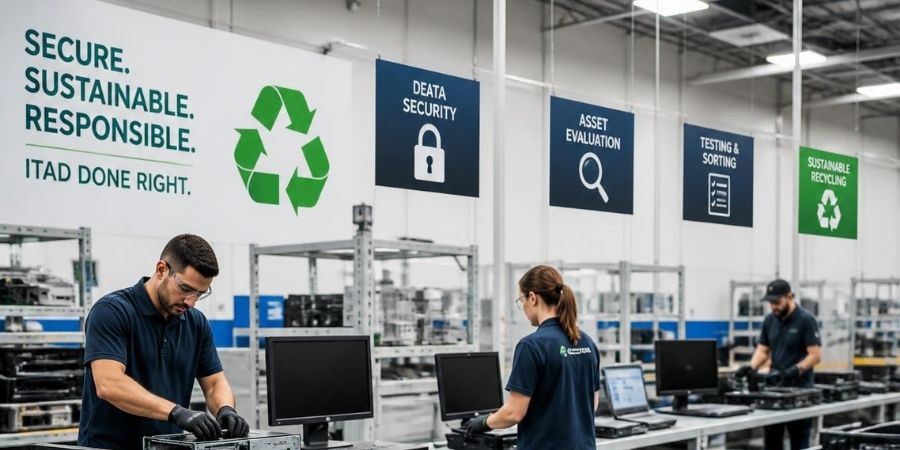
A company can replace hundreds of laptops, desktops, servers and networking devices over a few years. But once new equipment arrives, what happens to the old assets?
They may be moved into a storeroom, handed to another department, sold, recycled or simply left unused. The problem is that none of these options automatically guarantees that company data is secure, the asset is properly accounted for, or the equipment reaches an appropriate end-of-life channel.
This is where IT Asset Disposition (ITAD) comes in.
ITAD provides a structured way to manage technology assets when an organization no longer needs them. It can involve asset identification, secure data destruction, condition assessment, reuse, refurbishment, resale, recycling and responsible disposal.
For businesses, ITAD is not just about getting rid of old computers. It is about managing the transition from active technology to its next stage in a controlled and traceable way.
What Is IT Asset Disposition (ITAD)?
IT Asset Disposition, commonly shortened to ITAD, is the process of managing IT equipment after an organization decides it is no longer required for its current purpose.
This can include:
- Laptops and desktop computers
- Servers
- Hard drives and SSDs
- Monitors
- Printers and scanners
- Networking equipment
- Mobile phones and tablets
- Storage devices
- Other business technology assets
The important point is that an asset does not necessarily become waste the moment a company stops using it.
An old laptop may still be suitable for another employee. A server may have components with recovery value. A device that cannot be reused may still contain materials that can be recovered through appropriate recycling.
A good ITAD process considers these possibilities before deciding what should happen to the equipment.
Why Does IT Asset Disposition Matter?
ITAD matters because retired technology creates several business concerns at the same time.
Data security
A retired computer can still contain business information.
Deleting files, emptying the recycle bin or formatting a drive should not automatically be treated as secure data destruction. Depending on the storage technology and the organization’s requirements, a suitable sanitization or destruction method may be necessary.
This is especially relevant for businesses handling customer information, financial records, employee data, intellectual property or other confidential information.
Asset accountability
When an organization disposes of a large number of devices, it needs to know what happened to those assets.
Without proper records, it can become difficult to answer basic questions:
- Which devices were retired?
- Where are they now?
- Which assets were reused?
- Which storage devices were destroyed?
- Which equipment was recycled?
- What documentation was provided?
Asset tracking helps bring order to this process.
Value recovery
Not every retired device needs to go directly to recycling.
Some equipment may still have useful life. Depending on its condition, age, specifications and organizational requirements, it may be suitable for internal reuse, refurbishment or remarketing.
This is one reason ITAD is broader than simply “old computer disposal.”
Responsible recycling
Equipment that has reached the end of its useful life still needs to be handled appropriately.
Electronics contain recoverable materials as well as components that can create environmental and health concerns if handled improperly. Responsible recycling helps ensure that obsolete equipment enters appropriate processing channels instead of being treated as ordinary waste.
Compliance and documentation
Businesses may also have regulatory and internal governance requirements around electronic waste, information security and asset management.
In India, e-waste management is governed by the E-Waste (Management) Rules, 2022, which came into effect on April 1, 2023. The framework includes requirements for relevant stakeholders and an Extended Producer Responsibility mechanism for covered producers.
ITAD itself is not a substitute for understanding the specific regulations that apply to an organization. Instead, it can provide a structured operational process for retiring technology assets.
How Does the ITAD Process Work?
The exact workflow varies between organizations, but a practical ITAD process often follows a sequence like this.
1. Asset Identification and Inventory
The first step is knowing what is being retired.
An organization may record details such as:
- Asset type
- Serial number
- Asset tag
- Location
- Condition
- User or department
- Storage media
- Retirement status
For a company disposing of ten laptops, this may be relatively straightforward.
For a company managing thousands of devices across several offices, proper inventory becomes much more important.
2. Collection and Transportation
Once the assets are identified, they can be collected from the relevant offices, branches, data centers or storage locations.
The collection process should maintain appropriate records so that the organization knows what equipment has been handed over and what stage it has reached.
For larger projects, logistics planning can be just as important as the recycling itself.
3. Data Destruction
For equipment containing storage media, data security should be addressed before the asset moves further through the disposition process.
The appropriate method depends on the type of storage device and the organization’s security requirements.
Possible approaches can include secure data wiping or physical destruction of storage media when reuse is not appropriate.
The key point is simple: the device may be obsolete, but the data on it may still be valuable or sensitive.
4. Asset Assessment
After data handling, equipment can be evaluated based on its physical condition, specifications and potential next use.
The assessment can help determine whether an asset should be:
Reused → Refurbished → Remarketed → Recycled → Disposed of appropriately
This prevents usable equipment from automatically being treated as waste.
5. Reuse or Refurbishment
Some retired equipment can continue serving a purpose.
For example, a company may replace employee laptops as part of a technology refresh. Older devices that still meet certain requirements may potentially be refurbished or redeployed.
Reuse can extend the useful life of equipment, although the decision should always consider data security, device condition, performance and organizational requirements.
6. Recycling
Equipment that cannot reasonably be reused or refurbished can move into appropriate recycling channels.
During recycling, electronics may be dismantled and separated so that materials such as metals, plastics and other components can be recovered.
The recycling route should be appropriate to the equipment and applicable requirements.
7. Documentation and Closure
A professional ITAD process should not end when the equipment leaves the office.
Organizations may need records showing what happened to their assets, particularly when data security, internal audits, environmental reporting or governance requirements are involved.
The exact documentation available will depend on the service provider and the nature of the project.
ITAD vs. E-Waste Recycling: What’s the Difference?
These terms are closely related, but they describe different parts of the asset lifecycle.
E-waste recycling focuses on processing discarded electrical and electronic equipment to recover materials and manage waste responsibly.
IT Asset Disposition takes a broader view of technology assets after they are retired.
For example:
Company laptop → Asset identification → Data destruction → Assessment → Reuse/refurbishment OR recycling
The recycling stage may therefore be part of an ITAD program, rather than the entire ITAD process.
This distinction is useful for businesses because a retired laptop should not necessarily be treated as waste immediately. First, the organization needs to determine whether it can be securely reused or recovered.
Common ITAD Challenges and Mistakes
Treating disposal as a one-step process
“Send old computers to a recycler” sounds simple, but it leaves several questions unanswered.
Was the data removed securely? Were all assets accounted for? Could some equipment have been reused? Was the final processing traceable?
A structured ITAD process addresses these questions.
Keeping retired equipment in storage indefinitely
Companies often accumulate old equipment because disposal is postponed.
Over time, this creates storage problems and makes asset records harder to maintain.
A defined retirement process helps prevent the storeroom from becoming a permanent holding area for obsolete technology.
Assuming formatting equals secure data destruction
Formatting a drive should not automatically be considered sufficient for every business situation.
Organizations should determine the appropriate data sanitization or destruction method based on the device and sensitivity of the information involved.
Losing asset records
If equipment is collected without proper inventory, organizations can lose visibility over individual assets.
Serial numbers, asset tags and other relevant records can help maintain accountability.
Choosing a service provider based only on price
The cheapest disposal option may not provide the level of data security, documentation, traceability or recycling controls a business requires.
For sensitive corporate equipment, service scope matters more than collection alone.
Best Practices for Corporate IT Asset Disposition
A practical ITAD policy should fit the organization’s size and technology environment.
Some useful practices include:
- Maintain an updated IT asset inventory.
- Define when equipment should be retired.
- Separate active, reusable and end-of-life assets.
- Identify storage devices before collection.
- Establish an appropriate data destruction process.
- Keep records throughout the disposition process.
- Verify the relevant credentials or registrations of recycling partners.
- Consider reuse or refurbishment before recycling where appropriate.
- Keep documentation related to asset processing.
- Review the process periodically rather than treating ITAD as a one-time cleanup activity.
For organizations with frequent hardware refreshes, ITAD works best when it becomes part of the normal asset lifecycle rather than an emergency task whenever storage rooms become full.
When Should a Business Consider Professional ITAD Services?
Professional ITAD support can be particularly useful when the volume or sensitivity of equipment makes internal disposal difficult to manage.
Consider professional assistance when your business has:
- Large numbers of retired laptops or desktops
- Servers and networking equipment reaching end of life
- Sensitive information stored on old devices
- Multiple offices or collection locations
- Regular technology refresh cycles
- Equipment requiring secure data destruction
- A need for asset-level tracking
- Requirements for disposal or recycling documentation
- Electronic equipment that needs responsible end-of-life processing
For example, a company replacing 500 employee laptops has a very different disposal challenge from a small business retiring two computers.
At that scale, collection, asset tracking, data security, transportation and final processing all need to work together.
BRP Infotech provides IT Asset Disposition services for organizations looking to manage retired technology assets through a more structured process.
Where sensitive information is involved, data destruction services can also be considered as part of the asset retirement workflow.
ITAD and E-Waste Management in India
ITAD often overlaps with e-waste management, particularly when retired equipment reaches the end of its useful life.
India’s E-Waste (Management) Rules, 2022 provide the current regulatory framework for covered e-waste management activities. The framework includes Extended Producer Responsibility requirements for relevant producers and emphasizes environmentally sound recycling through appropriate registered recyclers.
For businesses, the practical takeaway is that electronic equipment should not simply be handed over to an unknown disposal channel.
The organization should understand what type of equipment it is retiring, whether the assets contain sensitive data, whether they can be reused, and which end-of-life route is appropriate.
Specific compliance responsibilities can vary depending on the organization’s role and the type of equipment involved, so businesses should verify the current requirements applicable to their situation.
A Simple ITAD Example
Consider an Indian IT company replacing 300 laptops across three offices.
Without a structured process, the company might collect the old laptops in a storage room and deal with them later.
A more organized ITAD approach could look like this:
Asset inventory → Collection → Data destruction → Condition assessment → Reuse/refurbishment where appropriate → Recycling → Documentation
This approach gives the company greater visibility over what happened to its equipment.
It also separates three issues that are often incorrectly treated as one:
What happens to the device?
What happens to the data?
What happens to the materials at the end?
ITAD brings these decisions into one controlled asset lifecycle.
Frequently Asked Questions
What does ITAD stand for?
ITAD stands for IT Asset Disposition. It refers to the process of managing technology assets when an organization no longer needs them, including data destruction, assessment, reuse, refurbishment, recycling and appropriate disposal.
What is included in ITAD?
ITAD can cover laptops, desktops, servers, storage devices, monitors, networking equipment, mobile devices and other business technology assets. The exact scope depends on the organization and its asset lifecycle.
Is ITAD the same as e-waste recycling?
No. E-waste recycling focuses on the responsible processing and material recovery of electronic waste. ITAD covers a broader process that can include inventory, data destruction, reuse, refurbishment, remarketing and recycling.
Why is data destruction important in ITAD?
Retired devices can still contain sensitive information. A suitable data destruction or sanitization process helps reduce the risk of confidential information remaining accessible after an asset leaves active business use.
Can old IT equipment be reused?
Yes, some retired equipment may still be suitable for reuse or refurbishment depending on its condition, specifications, age, security requirements and business needs.
What should businesses do with old hard drives?
Businesses should first determine whether the drives contain sensitive information and select an appropriate data sanitization or destruction method. After data security has been addressed, the drives can follow the appropriate reuse or recycling route.
When should a company use an ITAD service?
Professional ITAD services can be useful when a company is retiring large volumes of equipment, handling sensitive data, operating across multiple locations or requiring better asset tracking and disposal documentation.
Conclusion
IT Asset Disposition is more than removing old computers from an office.
A responsible ITAD process connects asset management, data security, reuse, recycling and responsible disposal into one organized workflow.
For businesses, that means having better visibility over retired equipment while reducing the risk of forgotten assets, unmanaged data and inappropriate disposal.
If your organization is preparing for an IT refresh, closing an office, replacing servers or dealing with a growing collection of obsolete equipment, it is worth planning the disposition process before the hardware becomes a storage problem.
For businesses that need structured support, BRP Infotech provides IT Asset Disposition solutions alongside related electronic waste and data destruction services.