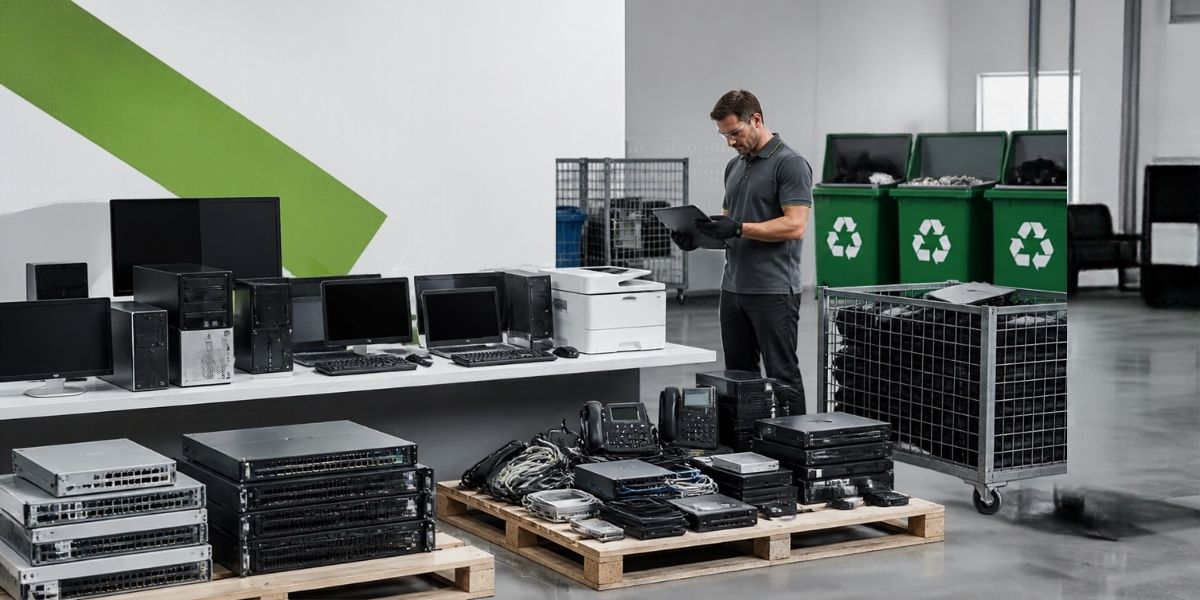
When a company upgrades its computers, replaces office equipment, or closes a branch, the work does not end when the new equipment arrives. Old laptops, printers, servers, networking devices, batteries, and other electronics still need a proper destination.
In many businesses, these items are moved into a storeroom and forgotten. Others are handed over to a scrap dealer without checking how the equipment will be handled. Both approaches can create problems, particularly when the devices contain confidential information or the waste requires specialised treatment.
Professional e-waste management services help businesses organise this process, from identifying unwanted equipment to arranging appropriate collection, data handling, reuse, and recycling. The goal is not simply to clear out old electronics. It is to manage them responsibly, maintain useful records, and reduce avoidable environmental and operational risks.
What Are Professional E-Waste Management Services?
Professional e-waste management services help organisations handle discarded electrical and electronic equipment through a structured process. Depending on the service and the equipment involved, this may include collection, segregation, assessment, refurbishment, secure data destruction, dismantling, recycling, and documentation.
Consider an office replacing 150 computers. Some machines might still be suitable for reuse, while others may be damaged or outdated. Storage drives could contain business records, and the equipment may include batteries that need separate handling.
Managing all these items independently can become difficult. A professional process helps the organisation identify what it has, determine the appropriate handling route, and keep track of the equipment until the relevant next steps are completed.
Businesses can explore e-waste management services to understand how electronic waste can be managed through a more organised approach.
Why Do Businesses Need Professional E-Waste Management Services?
1. To Handle Electronic Waste Responsibly
Offices generate electronic waste gradually. A few damaged keyboards or chargers may not seem significant, but equipment replacements over several years can leave businesses with substantial quantities of unwanted electronics.
Computers, monitors, printers, circuit boards, and other devices contain materials that can be recovered through appropriate recycling processes. They may also contain components that require careful handling.
When electronic waste is mixed with general rubbish or processed through unsuitable channels, valuable materials can be lost and harmful substances may be released into the environment.
Professional handling helps businesses segregate equipment and direct it towards suitable reuse, recycling, or treatment routes instead of treating everything as ordinary scrap.
2. To Protect Sensitive Business Data
An old computer can hold far more than its operating system and applications. It may contain customer records, employee information, financial documents, emails, passwords, or internal business files.
Deleting files or formatting a drive does not automatically establish that the data has been securely sanitised. The appropriate method depends on the storage technology, the device’s condition, and the organisation’s security requirements.
Before retiring computers, servers, storage devices, or multifunction printers, businesses should identify where information may be stored and establish a suitable sanitisation process.
For equipment that cannot be sanitised through an appropriate method, physical destruction of the storage media may be necessary. The organisation should retain relevant records of the process.
BRP Infotech provides information about its data destruction services, which businesses can review when planning the secure disposal of data-bearing equipment.
3. To Manage Corporate IT Assets More Effectively
IT equipment is often replaced in stages. One department may receive new laptops while another continues using older machines. Without proper asset tracking, organisations can lose sight of which devices are still in use, which have been transferred, and which are awaiting disposal.
This can complicate internal audits, equipment handovers, and retirement planning.
An organised asset management process records relevant details such as equipment type, serial number, department, condition, and disposal status. It can also help businesses identify equipment that may be suitable for redeployment rather than immediate recycling.
Companies can review asset management services to understand how structured asset tracking can support better control over equipment throughout its useful life.
4. To Support Applicable Environmental Compliance Responsibilities
E-waste management is not only an operational concern. Certain businesses also have responsibilities under India’s environmental regulations, depending on their role and the products or activities involved.
The E-Waste (Management) Rules, 2022, as amended, establish requirements for covered electrical and electronic equipment and relevant entities. Waste batteries are addressed separately under the Battery Waste Management Rules, 2022, and subsequent amendments.
A company should not assume that every business has the same legal obligations. Its responsibilities depend on factors such as whether it is a producer, manufacturer, refurbisher, recycler, or another type of entity covered by the applicable rules.
Where Extended Producer Responsibility (EPR) obligations apply, the organisation should verify its registration, documentation, and other requirements against the current official rules.
Businesses that need to understand producer-related responsibilities can review EPR services as a starting point for further discussion.
5. To Handle Battery Waste Safely
Laptops, phones, power backup systems, and other equipment may contain rechargeable batteries. Some batteries can present fire risks if crushed, punctured, short-circuited, or stored improperly.
Mixing battery waste with ordinary electronic scrap can make collection and transport more difficult. Damaged batteries may also require special precautions.
Businesses should identify battery types where possible, separate waste batteries from general electronic waste, and follow appropriate storage and transport guidance. They should not dismantle, crush, or attempt to repair damaged batteries without suitable expertise and equipment.
For organisations with recurring battery waste, battery waste disposal services provide a relevant starting point for planning appropriate handling.
6. To Make Equipment Retirement Easier During Office Changes
Office relocation, renovation, branch closure, and large-scale technology upgrades often generate different types of unwanted equipment at the same time.
A business may need to remove computers, printers, networking devices, furniture, and other office assets within a planned schedule. If electronic equipment is not identified and separated early, the process can become disorganised.
A planned retirement process helps teams identify which assets will be reused, which require secure data handling, and which need appropriate recycling or disposal.
For larger office clearances, businesses can review office dismantling services to assess whether specialised support is relevant to their requirements.
How Does Professional E-Waste Management Work?
The exact process varies according to the quantity and type of equipment, its condition, and the services required. A well-organised process generally includes the following stages.
Step 1: Inventory and assessment
The business identifies the equipment to be retired and records useful details such as asset numbers, serial numbers, quantities, and condition.
Step 2: Collection and transportation
Equipment is prepared for collection and transferred using suitable handling and transport arrangements. Batteries and damaged items may require additional precautions.
Step 3: Sorting and reuse assessment
The equipment is assessed to determine whether it can be repaired, refurbished, redeployed, or sent for recycling.
Step 4: Data sanitisation or destruction
Storage devices are handled according to the organisation’s data security requirements. Relevant evidence should be retained where required by internal policy or applicable obligations.
Step 5: Recycling and material recovery
Equipment that cannot be reused is directed to an appropriate recycling or processing route. Recyclable materials are recovered where feasible, and remaining waste is handled appropriately.
Step 6: Documentation and closure
The business maintains relevant collection, transfer, asset, data sanitisation, and recycling records. Documentation should reflect the work actually completed.
Businesses seeking to understand how equipment can be processed through recycling channels can review e-waste recycling and certification-related services. They should confirm the exact documentation and certification available for their specific requirement.
Common Mistakes Businesses Should Avoid
Even companies with established procurement and IT teams can overlook parts of the disposal process.
Common mistakes include:
- Keeping obsolete equipment indefinitely: Stored electronics take up space and become harder to track over time.
- Selling devices before addressing data security: Storage media should be sanitised appropriately before equipment changes ownership.
- Mixing batteries with general scrap: Battery waste may require separate collection and handling.
- Choosing a vendor based only on price: Businesses should check relevant registrations, the proposed handling process, downstream destinations, and documentation.
- Failing to maintain asset records: Without an inventory and handover trail, it can be difficult to establish what happened to retired equipment.
- Assuming every item must be recycled: Working equipment may be suitable for repair, redeployment, or refurbishment.
- Overlooking transportation arrangements: Moving equipment between offices or to a processing facility requires suitable planning and handling.
For organisations clearing equipment across multiple branches or locations, reverse logistics services may be relevant when coordinating collection and movement. The specific scope should be confirmed with the service provider.
Best Practices for Business E-Waste Management
A practical policy does not need to be complicated. It needs to be consistent and clear enough for employees, IT teams, procurement staff, and facility managers to follow.
Start by maintaining an updated inventory of electronic assets. Define who can approve retirement and who is responsible for data sanitisation, collection, and final documentation.
Before equipment leaves the premises, check for sensitive data, removable storage, built-in batteries, and any special handling requirements. Keep reusable equipment separate from damaged or non-repairable items.
When selecting a service provider, ask how the equipment will be collected, where it will be taken, how data-bearing devices will be handled, and what records will be supplied. Verify applicable registrations and authorisations rather than relying on verbal assurances.
Finally, review the process periodically. If the business regularly upgrades computers or operates several offices, a planned disposal schedule can make equipment retirement easier to manage.
When Should a Business Hire a Professional E-Waste Service Provider?
Professional support becomes particularly useful when a company is retiring large quantities of IT equipment, handling devices that contain confidential data, managing battery waste, relocating an office, or trying to maintain a clear record of its retired assets.
It may also help when the business needs to coordinate collections across multiple locations or understand how its particular environmental compliance responsibilities apply.
The right service depends on the requirement. IT asset disposition focuses on managing retired IT equipment; data destruction addresses information security; battery waste disposal deals with a separate waste stream; and e-waste management covers the broader handling of discarded electronics.
Businesses should discuss the scope in advance and confirm the provider’s capabilities, relevant registrations, documentation, and downstream handling arrangements.
Conclusion
Professional e-waste management helps businesses deal with more than unwanted equipment. It brings structure to asset retirement, supports responsible recycling, helps protect sensitive information, and makes relevant records easier to maintain.
The best time to establish a disposal process is before a major technology upgrade or office clearance begins. With a clear inventory, appropriate data handling, separate battery management, and a suitable recycling route, businesses can avoid many common problems.
If your organisation needs to manage retired computers, office electronics, or other electronic waste, BRP Infotech’s e-waste management services are a useful starting point for exploring an appropriate approach.
7. FAQs
1. Why do businesses need professional e-waste management services?
Businesses need these services to organise electronic waste collection, protect sensitive data, identify reusable equipment, manage batteries appropriately, and ensure waste reaches suitable recycling or treatment channels.
2. What types of business equipment are considered e-waste?
Common examples include desktop computers, laptops, servers, printers, monitors, networking equipment, electronic components, and other covered electrical and electronic equipment. Waste batteries are managed under a separate regulatory framework in India.
3. How does professional e-waste management protect business data?
A structured process identifies devices that may contain sensitive information and applies suitable data sanitisation or destruction methods before the equipment is reused or disposed of. Businesses should retain appropriate records of the process.
4. Is e-waste management mandatory for all businesses in India?
Not every business has identical obligations. The applicable requirements depend on the organisation’s role, the equipment involved, and relevant regulations. Businesses should check the latest official rules and seek appropriate compliance advice when needed.
5. What is the difference between e-waste management and IT Asset Disposition?
E-waste management focuses on the responsible handling of discarded electronics. IT Asset Disposition (ITAD) focuses on managing retired IT equipment, including assessment for reuse, data sanitisation, asset tracking, and appropriate end-of-life handling.
6. Why should businesses separate battery waste from electronic waste?
Some batteries can catch fire if damaged, crushed, or short-circuited. Separate collection and appropriate storage help reduce handling risks and ensure batteries reach suitable recycling channels.
7. What documents should a business request after e-waste disposal?
Depending on the service and applicable requirements, businesses may request collection records, asset handover details, data sanitisation or destruction evidence, and recycling or disposal documentation. Confirm which documents will actually be provided before arranging the service.